
PHARMACEUTICAL MANUFACTURING
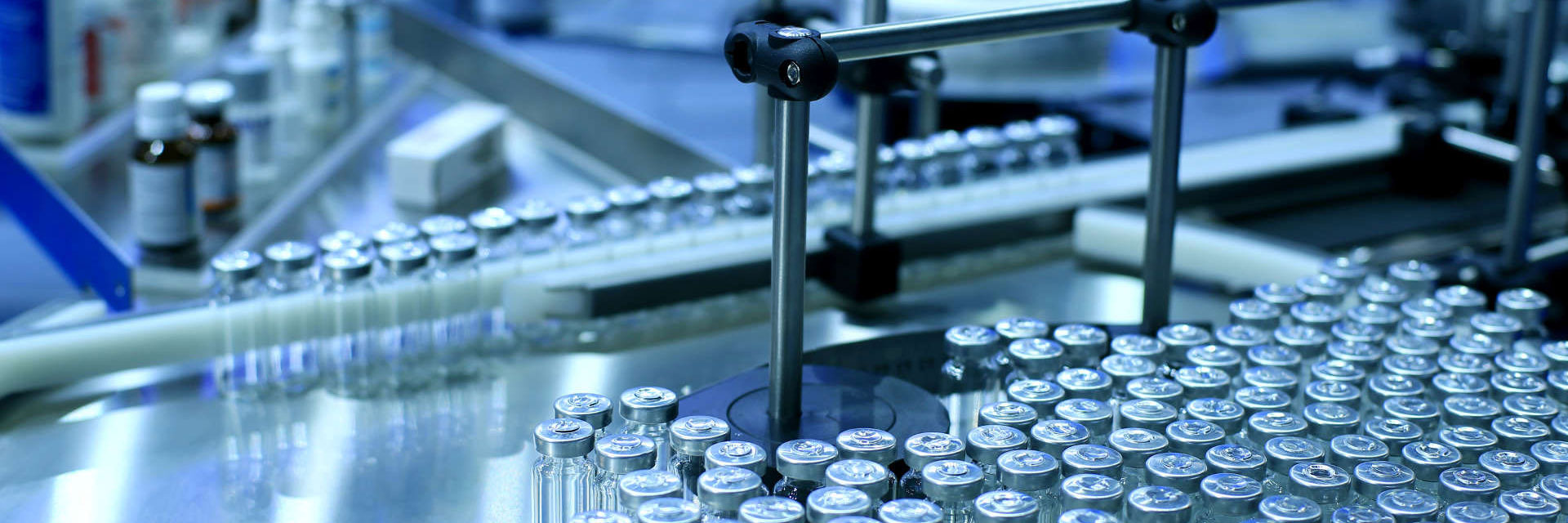
Pharmaceutical manufacturing is divided into two major stages. The first stage, which is typically referred to as primary processing or manufacture, is the production of the active ingredient or drug. The second stage, secondary processing, is the conversion of the active drugs into products suitable for administration. Throughout each and every stage, the importance of contamination elimination cannot be over looked.
High performance materials for demanding Pharmaceutical applications
With pharmaceutical sealing, materials need to demonstrate a range of properties including chemical compatibility, high temperature resistance, abrasion resistance and the capability to withstand aggressive cleaning regimes. The requirements for seal robustness are very high, for example, in tablet production where powders are processed.
During the production of chemically produced drugs API (Active Pharmaceutical Ingredients) or in vivo diagnostics (contrast agents, biomarkers), chemicals and toxic substances are used. Throughout organic synthesis, high temperatures and high pressures occur, whereas cooling (and low temperatures) takes place during the precipitation of the product. The temperature range is therefore quite substantial.
Because of the diverse demands of the Pharmaceutical industry, a number of high performance materials are required to satisfy the demand for superior chemical sealing, reliability and long service life:
*USP Class VI and FDA grades available. ** FDA grades available.
Quality and compliance are a top priority
In today’s pharmaceutical and bio-pharmaceutical industries, cleanliness, traceability and compliance with international regulatory standards (e.g. FDA/USP regulations) are essential for risk management. Employing durable, high-performance and precisely engineered sealing solutions is imperative to meeting these goals and preventing process material contamination.
In the pharmaceutical industry batch processing tends to be the norm. This ensures the traceability from the raw material supplier to the patient in the event of quality issues. It is therefore critical that seals comply with the increasingly stringent material quality and production standards.
To ensure the hygiene and purity of a batch, special attention must be paid to the documentation of the processes. It is therefore important to know the ingredients of the sealing materials, or appropriate confirmation of biocompatibility according to USP Chapter 88 (Class VI) must be available.
Pharmaceutical / Food industry standards, include;
• FDA (Food and Drug Standards).
• USP Class VI.
• 3A Sanitary Standard 18-03: Sanitary compounds.
• WRAS: Water Regulations Advisory Scheme.
• KTW.
• EC 1935-2004/ EC 2023-2006: Food Contact Materials – Health of consumer.
The Pharmaceutical segment includes a diverse range of applications
Pharmaceutical and Bio-Pharmaceutical equipment represents a wide range of applications and operating conditions. Sealing solutions must meet key operational needs with excellent chemical resistance and optimise the performance of a diverse range of media.
Example applications:
• Vertical / horizontal agitators.
• Mixers.
• Centrifugal pumps.
• Volumetric pumps.
• Tablet processing machines.
• Valves, Pumps, Gear Boxes.
METAL DETECTABLE O-RINGS
These seals help reduce the risk of product contamination by early detection and containment of contamination. Metal detectable O-rings decrease the risk of polymers finding their way into the finished product and supply chain.
Over time, processing equipment components in pharmaceutical applications can degrade. As elastomer seals degrade, there is an increased risk of rubber fragment contamination. If the rubber from a standard seal were to break down and find its way into the product, it would be extremely difficult, if not impossible, costly and very time-consuming to detect.
Metal detectable O-rings are manufactured from Silicone, Nitrile, EPDM and FKM compounds. The seals are available in blue or black for easy product identification, and offer extended lifetime performance.
ENCAPSULATED O-RINGS
Also known as FEPs and PFAs, Encapsulated O-rings are recommended when a standard O-ring has inadequate chemical resistance for an application, and a solid PTFE O-Ring does not have the elasticity for reliable, long term fluid sealing. Encapsulated O-rings have either a Viton or Silicone Core, however, a spring version is also available for Cryogenic applications.
SPRING O-RINGS
Industries including pharmaceutical, medical and chemical processing all encounter low temperature cryogenic conditions. They experience situations where it is very difficult to achieve effective liquid or gas sealing. Spring O-rings are ideal for sealing at extremely low temperatures where traditional elastomers suffer from brittleness. Low compression sets allow effective sealing as low as -250°C in Cryogenic applications. Spring O-rings utilise a precision rolled flat strip spring in 301 stainless steel (AMS 5519N). These seals are specially formed to energize a seamless jacket of Fluoropolymer (FEP or PFA).
INFLATABLE SEALS
Inflatable seals offer unique mechanical and chemical properties that make them ideal solutions to a wide range of pneumatic sealing challenges in pharmaceutical applications. Inflatable Seals have hollow profiles, sealed to be air tight. The benefit of inflatable seals is the individual pressure they can apply to varying seal gaps, making them suitable for sealing airlock doors and hatches, or in dome valves and sterilising equipment.
Gaskets or re-clamps components often have to be re-bolted when they move in relation to the contact surface, whereas inflatable seals unseal and inflate, resulting in the process being much more efficient.
GL-Provent S.L. supply dependable, compliant seals that meet key operational needs with excellent chemical resistance and remarkably long service life. We recognise the demands of the Pharmaceutical industry are constantly changing and as a responsible supplier, we offer materials to comply with the regulations and requirements including FDA and EU Legislation.
We offer a full range of O-rings from standard materials to metal detectable, USP Class VI seals. Our FEP Encapsulated O-rings are also fully compliant to all requirements stipulated on FDA and EC Regulation, on materials and articles intended to come into contact with products manufactured for the Pharmaceutical industry.